yue2 huggingface
Open music generation from lyrics and style prompts, with vocal songs, editable ABC scores, cover workflows, agentic editing, and local GPU inference.
Screenshots
Overview
Product overview
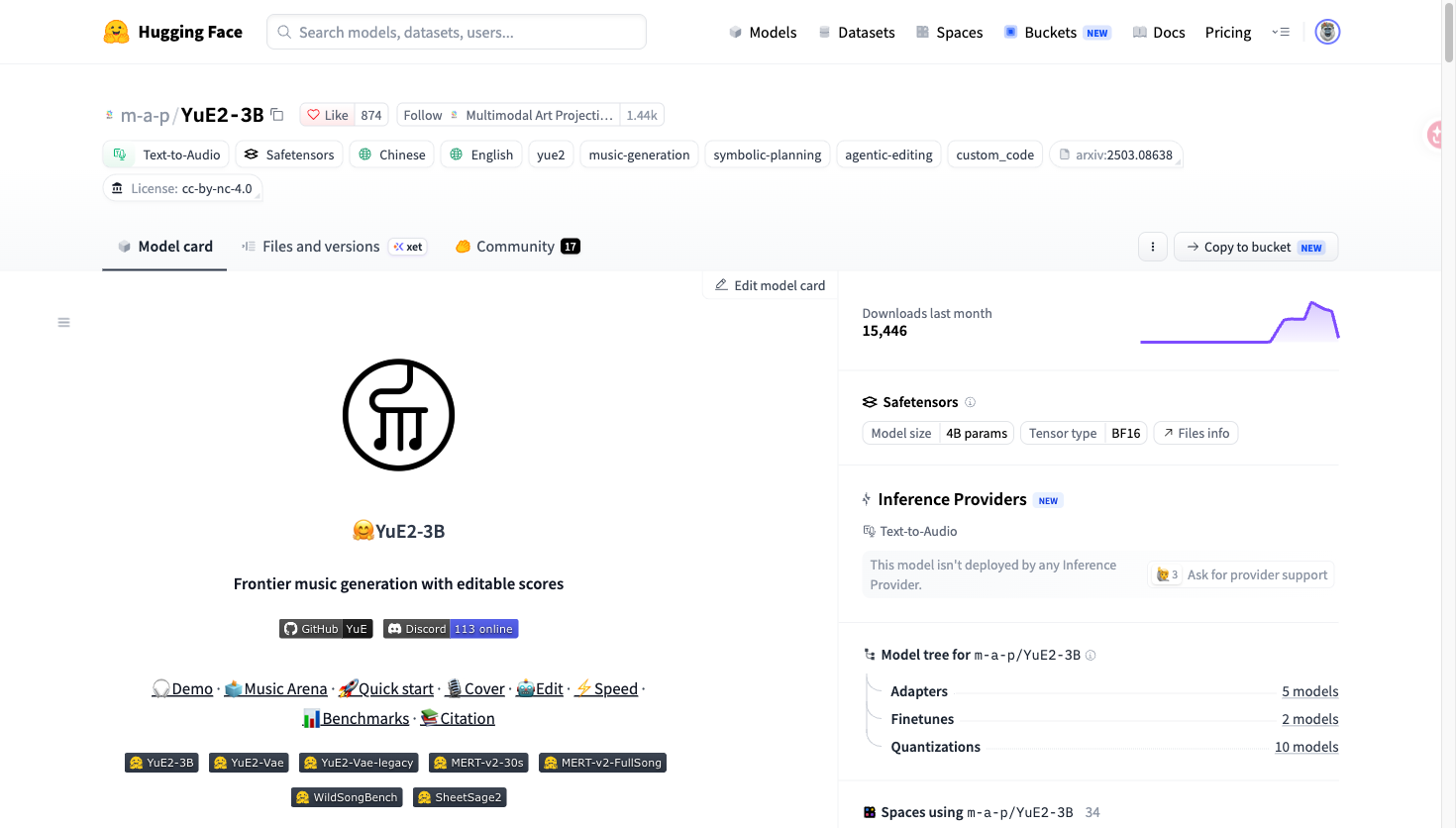
YuE2-3B is an open music-generation model from m-a-p, published as a Hugging Face model repository. It turns lyrics and a style prompt into a complete song with vocals and accompaniment, and supports score-guided composition, cover generation, and iterative editing. The model card presents Text-to-Audio use, English and Chinese support, 4B parameters in BF16, and a CC BY-NC 4.0 license.
Core features
- Generate full songs with melody and chord planning, melody-only planning, or direct generation.
- Provide an ABC score to guide melody and harmony, then save FLAC audio and editable artifacts including ABC, tokens, latents, and settings.
- Create a cover arrangement from an existing recording by preparing a melody score, lyrics, and a target style.
- Use an agentic editing workflow to revise lyrics, style, melody, chords, or arrangement across multiple versions.
- Load the pipeline with Hugging Face, use CFG text guidance, and work with separate planning and synthesis APIs.
- Run local inference for 48 kHz stereo songs on a 24GB NVIDIA GPU with BF16 support; the model card documents RTX 4090 timings and VRAM measurements.
How to use
- On Linux with Python 3.10+ and a compatible NVIDIA GPU, install the documented inference package.
- Load m-a-p/YuE2-3B with YuE2Pipeline and provide a style prompt, lyrics, optional ABC score, and seed.
- Generate a song or cover, save the FLAC output, and export the score and other artifacts.
- Edit the score or prompts and render another version, then compare the output with the listening demos and WildSongBench results.
Audience and availability
YuE2-3B is aimed at researchers, developers, musicians, and producers exploring local text-to-audio, vocal demos, cover arrangements, score-guided composition, and agentic song editing. The public page does not list a paid plan. Local use requires the stated Linux/Python environment, a compatible 24GB GPU, and compliance with CC BY-NC 4.0. The page currently says the model is not deployed by an Inference Provider.